Last Sunday I went to the Po Lin Monastery on Lantau Island where the "Big Buddha" is. I went with Brian and a couple other of his friends from the States. There is a train stop at the base of the mountain that has a cable car that goes strait to the monastery. We, however, decided to take the long route which turn out to be a mistake. We first took the train from CUHK to the tip of Kowloon to find the ferry to Lantau. We discovered that the only place to get a ferry to Lantau was at the Central Piers on Hong Kong Island. So we took a ferry across to Central and then figured out which boat we needed. We waited 30 minutes until the ferry we wanted arrived. The boat ride was then about an hour long. Once we got to Lantau we had to take a bus to get to the monastery. This was another hour long ride. The reason the bus took so long is that Lantau is very mountainous. Even though the length of the bus ride was a little annoying, it was neat to go through the mountains and forests on Lantau. That day was very very cloudy and the mountains were so high we drove up into the clouds. We were pretty happy once we got to the monastery since it had taken us about four hours to get there. Unfortunately, since it was so cloudy we could not see much. There were stairs that you had to walk up to get to the Buddha, but you couldn't see the top of the stair case. Once we got to the top, we could only see the outline of Buddha, but that in its self was neat. Inside the Big Buddha was a museum. It had all kinds of neat artwork but everything was explained in Chinese, so I have no idea what it actually was. We then walked back down to the monastery to get lunch. It was all vegetarian but very good. We explored the temple nearby for a little bit before deciding to head back down. We did not want to spend forever getting back to CUHK so we took the cable car. The cable car ride was actually a lot longer then I had expected, about 45 minutes. By that time it had gotten so cloudy that if another car was coming the other direction you could only see it for a couple of seconds, not to mention for the most part you couldn't see the ground. Near the end we descended enough to be outside of the clouds. We got a very high birds eye view of the Hong Kong Airport which was neat. Once we got back on the ground we took the train back to CUHK.
Album -
http://www.facebook.com/album.php?aid=2292532&id=7725102&l=7c2a90ba01
Showing posts with label Buddha. Show all posts
Showing posts with label Buddha. Show all posts
Tuesday, March 31, 2009

Wednesday, March 11, 2009
Siem Reap: Day Three
We woke up very early at 4:30AM. Tong picked us up outside our hostel at 5 so that we could go to Angkor Wat for the sunrise. We bought tickets for the day which got us into not only Angkor Wat but pretty much all the other ruins in the area. We were dropped off at the ancient bridge that goes over the moat. We were told to walk about a kilometer and then find a high place to watch the sun rise. Since it was completely dark (they had no lights what so ever in the are) we had to guess where we were going. Once we got across the bridge we had to go through the gate which meant we had to go inside the wall for a while. It was kind of cool wondering around ancient ruins in the pitch dark (also a big tricky since there were a lot of steps involved). We made it to an area we thought was good for watching the sunrise but as soon as the light started coming up we moved around a lot to see it from different angles. There is really no way to describe it, pictures are the closest thing to doing it.
After the sun was up we went back to town for a quick breakfast and then came back to Angkor Wat to wonder around for a few hours. I don't know if there is much to say other then to look at the pictures. The temple had been modified several times and damaged in various wars from the time it was built to the Cambodian revolution just a few decades ago. Originally it was a Hindu temple but then it was converted to a Buddhist temple some years later.
The next place we went to was Angkor Thom. This was the ancient capital of the Khmer Empire. Angkor Wat was the major temple for the city (angkor means "city," wat means "temple"). Inside the walls of Angkor Thom were all kinds of other temples and ruins. The first temple we went to was the Bayon Temple. It had 54 towers (for the 54 provinces of the Khmer Empire) but several have since fallen down. It was a Buddhist temple and each tower had 4 unique Buddha faces each facing a different direction. After wondering around for a bit, Wes decided to go back to the hostel while Francesca and I looked around Angkor Thom some more. We saw the Baphuon Temple, which was a Buddhist temple they were working on reconstructing.
  Several decades ago, they took it all part to study it in depth and then do a good job reconstructing it. The problem is that while it was all in pieces, civil war broke out and the documents explaining how to put it back together were destroyed. So now progress is really slow and out side there are rows and rows of stone blocks they have no idea where to put. Next to that was the Elephant Terrace which was a big stone platform used by the public to watch public events such as parades.
  It was quite long and had many carvings (mostly of elephants) all along the edge. Then, on the end of that ruin was the Leopard Terrace. They believe it was used as a crematorium and the statue on top was for the god of death. The last thing Fransesca and I looked at in Angkor Thom was a series of 12 identical towers used as a prison. We then found Tong in the market near by to drive us down the road to see other places.
The next temple we went to was the Ta Prohm Temple. This was a Buddhist temple that was completely taken over by the jungle. It was also used in the filming of the movie "Tomb Raider." The temple was very interesting. A large portion of it was destroyed and many hallways were blocked off. Giant trees were growing on the temple, often up on top of the roof and their roots would flow over the side of the stone like waterfalls. Just down the road was the Banteay Kdei temple which was another Buddhist temple. It was an interesting temple, but nothing that unique. By this time Francesca and I were exhausted and had Tong take us back to the hostel. There we rested and got dinner at a small little place just down the road. Again it was very very good.
At 7PM we went to a concert performed by a Swiss doctor, Dr. Beat Richner, known by his stage name Beatocello (he plays the cello). Dr. Richner has worked at helping Cambodian children since the 1970s. In the 90's he started building children's hospitals which are now located in Phnom Penh and Siem Reap. He plays every weekend to try to help raise money for his cause. 10% of the hospital's budget comes from Switzerland, 3% from Cambodia, and the rest come from donations. They cover all Cambodian children of free (including operations and medication) and never turn any away. He also insists on keeping the hospital up to Western standards. Over the past couple of decades his hospitals have reduced child mortality rates by about 90%. Dr. Richner was an interesting guy with a sense of humor but some how found himself being political near the end (which he claims he tries to avoid because the Chinese tend to get upset).
Album:
http://www.facebook.com/album.php?aid=2285736&id=7725102&l=68426
http://www.facebook.com/album.php?aid=2285740&id=7725102&l=574f3

After the sun was up we went back to town for a quick breakfast and then came back to Angkor Wat to wonder around for a few hours.
 I don't know if there is much to say other then to look at the pictures. The temple had been modified several times and damaged in various wars from the time it was built to the Cambodian revolution just a few decades ago. Originally it was a Hindu temple but then it was converted to a Buddhist temple some years later.
The next place we went to was Angkor Thom. This was the ancient capital of the Khmer Empire. Angkor Wat was the major temple for the city (angkor means "city," wat means "temple"). Inside the walls of Angkor Thom were all kinds of other temples and ruins. The first temple we went to was the Bayon Temple.
 It had 54 towers (for the 54 provinces of the Khmer Empire) but several have since fallen down. It was a Buddhist temple and each tower had 4 unique Buddha faces each facing a different direction. After wondering around for a bit, Wes decided to go back to the hostel while Francesca and I looked around Angkor Thom some more. We saw the Baphuon Temple, which was a Buddhist temple they were working on reconstructing.
  Several decades ago, they took it all part to study it in depth and then do a good job reconstructing it. The problem is that while it was all in pieces, civil war broke out and the documents explaining how to put it back together were destroyed. So now progress is really slow and out side there are rows and rows of stone blocks they have no idea where to put. Next to that was the Elephant Terrace which was a big stone platform used by the public to watch public events such as parades.
  It was quite long and had many carvings (mostly of elephants) all along the edge. Then, on the end of that ruin was the Leopard Terrace. They believe it was used as a crematorium and the statue on top was for the god of death. The last thing Fransesca and I looked at in Angkor Thom was a series of 12 identical towers used as a prison. We then found Tong in the market near by to drive us down the road to see other places.
The next temple we went to was the Ta Prohm Temple. This was a Buddhist temple that was completely taken over by the jungle.
 It was also used in the filming of the movie "Tomb Raider." The temple was very interesting. A large portion of it was destroyed and many hallways were blocked off. Giant trees were growing on the temple, often up on top of the roof and their roots would flow over the side of the stone like waterfalls. Just down the road was the Banteay Kdei temple which was another Buddhist temple. It was an interesting temple, but nothing that unique. By this time Francesca and I were exhausted and had Tong take us back to the hostel. There we rested and got dinner at a small little place just down the road. Again it was very very good.
At 7PM we went to a concert performed by a Swiss doctor, Dr. Beat Richner, known by his stage name Beatocello (he plays the cello). Dr. Richner has worked at helping Cambodian children since the 1970s. In the 90's he started building children's hospitals which are now located in Phnom Penh and Siem Reap. He plays every weekend to try to help raise money for his cause. 10% of the hospital's budget comes from Switzerland, 3% from Cambodia, and the rest come from donations. They cover all Cambodian children of free (including operations and medication) and never turn any away. He also insists on keeping the hospital up to Western standards. Over the past couple of decades his hospitals have reduced child mortality rates by about 90%. Dr. Richner was an interesting guy with a sense of humor but some how found himself being political near the end (which he claims he tries to avoid because the Chinese tend to get upset).
Album:
http://www.facebook.com/album.php?aid=2285736&id=7725102&l=68426
http://www.facebook.com/album.php?aid=2285740&id=7725102&l=574f3
Friday, February 27, 2009
Yangshuo: Day Three
We planned on meeting outside the hostel at 11am to head out for breakfast. Since we could only fit four to a room the French were in one room while the rest of us where in another. Nolwenn, Marie, and Adrien also were leaving that night since they has classes on Monday they did not want to miss. So they were going to check out at 11am while we gathered together. However, we encountered another problem with the staff at the Yo Yao Hotel. One of the staff members checked them out by looking at the room to see if anything was wrong. They found that part of the toilet seat was broken. The French knew about this but only discovered it late the night before which was the first time they used it. The staff was refusing to return their deposit (50 yuan) due to damages. The real suspicious thing was that when the room was inspected, the staff member went straight to the toilet and looked at nothing else. After a long long session of arguing (mostly through Mandy since the staff could only speak broken English at best) a older man came in. We assumed he was the husband of the lady we were arguing with the most and the owner. He seemed to be more co-operative then anyone else we had dealt with at this hotel. He just said that they should pay what ever they feel like they should. The French decided to split the deposit and take only 25 yuan back. The rest of us decided we should check out too as we have been annoyed enough with this place. After successfully checking out of the Yo Yao Hotel, we went down the street a little ways to a restaurant we saw that had dumplings to get breakfast. It was very good and again cheap (12 yuan for 12 dumplings). While eating breakfast various locals would come by and try to sell us stuff. For the most part we would turn them away. But one local was trying to offer to be our tour guide for the day. Since we didn't have much of a plan yet we agreed to hire her. She charged us 50 yuan for the whole day split between the seven of us (that would be about US$1.10 each). We then rented bikes (ranging from 10 yuan to 20 yuan for the whole day) so we could go out and see stuff in the country side.
Our tour guide, Linda, took us outside of the town. This was the first time that we had left the few blocks that tourist usually stay in. The town of Yangshuo was a little bit bigger then I had assumed but it was still fairly small (maybe a tad smaller then Orrville). In any case, it did not take us long to get into farming land. All of Yangshuo and the surrounding areas are noticeable richer then most of China. It is still very poor, but at least everything is well maintained and people at the very least seem to have something to do to stay busy. The farming in the area seemed very traditional.
  All the farms were perfectly well kept with everything planted in very nice rows. The amazing thing was that it was all done by hand. There were no tractors, no machinery, just men with simple gardening tools. All the plots were way too small for any modern day equipment to be practical. A lot of the famers were trying to sell their goods either in town or along side the road. The popular one was oranges but it didn't look like much else was in season (a couple of places did have strawberries). The condition of the roads varied greatly, and often had no subtly transition. One minute you would be on recently paved road that obviously had a lot of time and resources put into it (not like the chip and seal stuff we have in the country back home) and the next minute you would be on a dirt road with no gravel. Most of the houses were small two story brick buildings. The brick was the local imperfect hand made type, and the few buildings we saw under construction seemed to be progressing very slowly (I think they were all individuals building the houses). Farm animals seemed to roam about freely. I saw plenty of oxen go between houses and on into fields. They seemed well trained though. At one point we passed a local taking 3 oxen (including a calf) down the road. He walked with one of the oxen while the other two followed and didn't seem to care that we were riding by them on bikes. Chickens were a common sight too. They seemed just as comfortable hanging out with humans as they did themselves. At one point we came to a Buddhist temple, Jianshan Temple.
  There wasn't anything unique to this temple but since we had a guide with us she explained a lot of things, like how to pray. You kneel before the statue and bow three times for good luck. Each time we bowed a monk near by would bang a gong. It was pretty neat to finally understand what was going on. We continued on to look into some water caves near by but ultimately decided to head back to Yangshuo since it was getting late. We needed to grab dinner in time for the French to make their bus. We dropped our bikes off and on the way to the restaurant we checked in to a different hotel. It was not a nice as the night before but we got two rooms with two large beds each and a private bathroom for each room at a cheaper price so it was not that bad. We ended up eating dinner at the same place we had breakfast at since it was so good. The staff there really liked us as we were able to talk to them about celebrities (they really liked Brittney Spears and Michael Jackson) and we helped them with some English translations. After dinner Nolwenn, Marie, and Adrien left while Kalen, Chase, Mandy and myself wondered around town to enjoy Yangshuo at night.
  Night is when the markets become real active and the street is accented with all the neon lights. After a couple of hours checking out different places were went to bed.
Album:
http://www.facebook.com/album.php?aid=2282959&id=7725102&l=8c380
I also added video to the last post. I have been experimenting around with it on my camera and by no means is the video that amazing. I missed videoing a lot of the cool stuff.
Our tour guide, Linda, took us outside of the town.
 This was the first time that we had left the few blocks that tourist usually stay in. The town of Yangshuo was a little bit bigger then I had assumed but it was still fairly small (maybe a tad smaller then Orrville). In any case, it did not take us long to get into farming land. All of Yangshuo and the surrounding areas are noticeable richer then most of China. It is still very poor, but at least everything is well maintained and people at the very least seem to have something to do to stay busy. The farming in the area seemed very traditional.
  All the farms were perfectly well kept with everything planted in very nice rows. The amazing thing was that it was all done by hand. There were no tractors, no machinery, just men with simple gardening tools. All the plots were way too small for any modern day equipment to be practical. A lot of the famers were trying to sell their goods either in town or along side the road. The popular one was oranges but it didn't look like much else was in season (a couple of places did have strawberries). The condition of the roads varied greatly, and often had no subtly transition. One minute you would be on recently paved road that obviously had a lot of time and resources put into it (not like the chip and seal stuff we have in the country back home) and the next minute you would be on a dirt road with no gravel. Most of the houses were small two story brick buildings. The brick was the local imperfect hand made type, and the few buildings we saw under construction seemed to be progressing very slowly (I think they were all individuals building the houses). Farm animals seemed to roam about freely. I saw plenty of oxen go between houses and on into fields. They seemed well trained though. At one point we passed a local taking 3 oxen (including a calf) down the road. He walked with one of the oxen while the other two followed and didn't seem to care that we were riding by them on bikes. Chickens were a common sight too. They seemed just as comfortable hanging out with humans as they did themselves. At one point we came to a Buddhist temple, Jianshan Temple.
  There wasn't anything unique to this temple but since we had a guide with us she explained a lot of things, like how to pray. You kneel before the statue and bow three times for good luck. Each time we bowed a monk near by would bang a gong. It was pretty neat to finally understand what was going on. We continued on to look into some water caves near by but ultimately decided to head back to Yangshuo since it was getting late. We needed to grab dinner in time for the French to make their bus. We dropped our bikes off and on the way to the restaurant we checked in to a different hotel. It was not a nice as the night before but we got two rooms with two large beds each and a private bathroom for each room at a cheaper price so it was not that bad. We ended up eating dinner at the same place we had breakfast at since it was so good. The staff there really liked us as we were able to talk to them about celebrities (they really liked Brittney Spears and Michael Jackson) and we helped them with some English translations. After dinner Nolwenn, Marie, and Adrien left while Kalen, Chase, Mandy and myself wondered around town to enjoy Yangshuo at night.
  Night is when the markets become real active and the street is accented with all the neon lights. After a couple of hours checking out different places were went to bed.
Album:
http://www.facebook.com/album.php?aid=2282959&id=7725102&l=8c380
I also added video to the last post. I have been experimenting around with it on my camera and by no means is the video that amazing. I missed videoing a lot of the cool stuff.
Monday, January 19, 2009
10,000 Buddhas and a McDonalds
Sunday Chris, Jacque, Jesse, and I decided to do something touristy. We wanted to visit the Temple of 10,000 Buddhas. Chris had a guide book to Hong Kong that said we needed to get off of the train at the Tai Wai stop. It then said that we just have to follow the signs to get to the temple. This was perfect since Tai Wai was only 3 stops down from University (the stop on campus). When we got off at Tai Wai we started looking for signs to the temple. We found a map of the local area around the station, but Temple of 10,000 Buddhas was not on it. Not too far away there was a temple called Che Kung Temple. We wondered if that might be another name for the 10,000 Buddhas, so we wandered over that direction.

Che Kung Temple had a walled court yard with gates to the outside. On one side of the courtyard was a building that contained a shrine. We noticed a lot of commotion inside the court yard as people were praying. We were not sure if we should go in (or were allowed) but the man at the door encouraged us to go in. He didn't speak English but was very excited and waved us in. Once inside, we noticed almost everyone burning incense and praying. Although there were variations on how it was done, it seemed common to take the incense stick between your hands, which were clasped similar to how Christians pray, hold your hands up to your forehead and then bow multiple time in succession. There was no leader, and it seemed each individual prayed separately in their own way at their own time. It didn't seem like a family event, there were no children but we did see what looked like couples having their fortunes told. There were chimes hit a certain number of times followed by a big drum being hit a certain number of times. We walked cautiously in the building with the shrine. Inside was a giant statue in armor which was too tall for me to see his face. This is what people were praying to and leaving offerings. At this point we decided that this was not the Temple of 10,000 Buddhas and decided to wander down the path. There was a map we found that had a suggested walking trail (mostly for tourist) that we determined had to eventually lead to the Temple of 10,000 Buddhas. It didn't take us long to come to another shrine.

I am not sure what it is called but it was all outdoors and a lot smaller. It also was not on the map. There were fewer people inside but we did see a shrine to what I later determined to be Avalokiteśvara which is a figure in Buddhism. Again there was incenses everywhere. There were pots all over the place that had many sticks of it burning. We decided to continue on to the next place the map suggested called Tsang Tai Uk. We didn't know what it was, but we knew we just wanted to see it. When we turned the corner that was suppose to have Tsang Tai Uk we didn't see anything but tennis courts. They were called "Tsang Tai Uk Temporary Recreational Park." Everyone felt that the tennis courts was it and just sat down for a break. However, I decided to go a little further down the road to see if I could find anything else.

After turning the corner I found the Tsang Tai Uk, which is a mid 19th century stone village. It is still being used as residence and was not that exciting. We then continued on and crossed a canal. On the other side was the Hong Kong Heritage Museum. We decided to look around in side since it was air conditioned and only HK$5. Inside we saw all kinds of art and displays from various cultures within China. There were also historical displays on the development of Hong Kong. After spending some time inside we left and crossed the street to get our bearings. We then realized that we were next to New Town Plaza which is the ridiculously large mall that contained the Sha Tin station. We had walked from one train station to the next and still hadn't found the Temple of 10,000 Buddhas. Chris's book mislead us. In any case by this time we were very hungry and just wanted food. So we went to a McDonalds inside the mall. This McDonalds was packed. We got a quick bit to eat which was nice since it was the first time I had ice cream and a hamburger since getting into Hong Kong. Afterwards we debated about whither or not we should continue looking for the Temple of 10,000 Buddhas. We found a map of the Sha Tin station area and discovered that the Temple was on the other side of the station. In fact we could see on the mountain side from the train station. So we walked that direction.
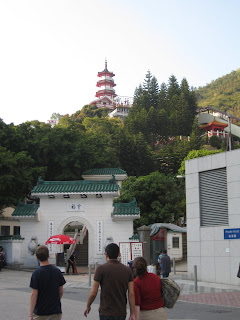
This is what we thought was the entrance to the Temple of 10,000 Buddhas. It looked very nice and religious. A short walk up the hill we found shrines to Avalokiteśvara and Buddha. We continued almost all the way up until we got to some buildings. Inside one there were monks gathered around a couple of tables chanting. In most of the buildings it seemed to have pictures of people (I assumed deceased) much like a mausoleum. There were lots of Chinese around us praying and leaving offerings. Nothing was in English. When we got to one side of the top we looked at the compound right next to us and could see statues of golden monks. It was at that point we decided (yet again) that we were not in the Temple of 10,000 Buddhas, but this time we knew where we had to go and were very confident about it. The only problem was that we had to go back down the mountain in order to get on the right path to climb back up the mountain.
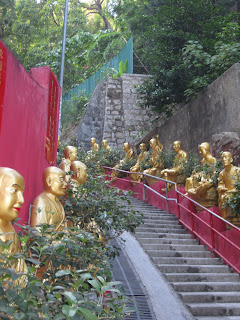
The path up the mountain was long and very steep. Statues of monks covered the entire path. The top was rather awesome. There was the Temple of 10,000 Buddhas, more statue monks, giant statues of other Buddhist figures, a tower, and other structures.

Inside the temple, there were Buddhas covering the wall. Each little statue was unique. We climbed the tower that was nearby for an amazing view of the temple and the city of Sha Tin. The path we took didn't end at the temple, so we continued on up the mountain. There were still statues but they became more diverse. Some were of female figures while others seemed more warrior like. There was another small shrine to Buddha and another mausoleum. After that we were so exhausted we all just wanted to go back to CUHK.

Che Kung Temple had a walled court yard with gates to the outside. On one side of the courtyard was a building that contained a shrine. We noticed a lot of commotion inside the court yard as people were praying. We were not sure if we should go in (or were allowed) but the man at the door encouraged us to go in. He didn't speak English but was very excited and waved us in. Once inside, we noticed almost everyone burning incense and praying. Although there were variations on how it was done, it seemed common to take the incense stick between your hands, which were clasped similar to how Christians pray, hold your hands up to your forehead and then bow multiple time in succession. There was no leader, and it seemed each individual prayed separately in their own way at their own time. It didn't seem like a family event, there were no children but we did see what looked like couples having their fortunes told. There were chimes hit a certain number of times followed by a big drum being hit a certain number of times. We walked cautiously in the building with the shrine. Inside was a giant statue in armor which was too tall for me to see his face. This is what people were praying to and leaving offerings. At this point we decided that this was not the Temple of 10,000 Buddhas and decided to wander down the path. There was a map we found that had a suggested walking trail (mostly for tourist) that we determined had to eventually lead to the Temple of 10,000 Buddhas. It didn't take us long to come to another shrine.

I am not sure what it is called but it was all outdoors and a lot smaller. It also was not on the map. There were fewer people inside but we did see a shrine to what I later determined to be Avalokiteśvara which is a figure in Buddhism. Again there was incenses everywhere. There were pots all over the place that had many sticks of it burning. We decided to continue on to the next place the map suggested called Tsang Tai Uk. We didn't know what it was, but we knew we just wanted to see it. When we turned the corner that was suppose to have Tsang Tai Uk we didn't see anything but tennis courts. They were called "Tsang Tai Uk Temporary Recreational Park." Everyone felt that the tennis courts was it and just sat down for a break. However, I decided to go a little further down the road to see if I could find anything else.

After turning the corner I found the Tsang Tai Uk, which is a mid 19th century stone village. It is still being used as residence and was not that exciting. We then continued on and crossed a canal. On the other side was the Hong Kong Heritage Museum. We decided to look around in side since it was air conditioned and only HK$5. Inside we saw all kinds of art and displays from various cultures within China. There were also historical displays on the development of Hong Kong. After spending some time inside we left and crossed the street to get our bearings. We then realized that we were next to New Town Plaza which is the ridiculously large mall that contained the Sha Tin station. We had walked from one train station to the next and still hadn't found the Temple of 10,000 Buddhas. Chris's book mislead us. In any case by this time we were very hungry and just wanted food. So we went to a McDonalds inside the mall. This McDonalds was packed. We got a quick bit to eat which was nice since it was the first time I had ice cream and a hamburger since getting into Hong Kong. Afterwards we debated about whither or not we should continue looking for the Temple of 10,000 Buddhas. We found a map of the Sha Tin station area and discovered that the Temple was on the other side of the station. In fact we could see on the mountain side from the train station. So we walked that direction.

This is what we thought was the entrance to the Temple of 10,000 Buddhas. It looked very nice and religious. A short walk up the hill we found shrines to Avalokiteśvara and Buddha. We continued almost all the way up until we got to some buildings. Inside one there were monks gathered around a couple of tables chanting. In most of the buildings it seemed to have pictures of people (I assumed deceased) much like a mausoleum. There were lots of Chinese around us praying and leaving offerings. Nothing was in English. When we got to one side of the top we looked at the compound right next to us and could see statues of golden monks. It was at that point we decided (yet again) that we were not in the Temple of 10,000 Buddhas, but this time we knew where we had to go and were very confident about it. The only problem was that we had to go back down the mountain in order to get on the right path to climb back up the mountain.

The path up the mountain was long and very steep. Statues of monks covered the entire path. The top was rather awesome. There was the Temple of 10,000 Buddhas, more statue monks, giant statues of other Buddhist figures, a tower, and other structures.

Inside the temple, there were Buddhas covering the wall. Each little statue was unique. We climbed the tower that was nearby for an amazing view of the temple and the city of Sha Tin. The path we took didn't end at the temple, so we continued on up the mountain. There were still statues but they became more diverse. Some were of female figures while others seemed more warrior like. There was another small shrine to Buddha and another mausoleum. After that we were so exhausted we all just wanted to go back to CUHK.
Subscribe to:
Posts (Atom)